
The Anxiety Stack: Using Customer Interviews to Find and Solve the Real Barriers to Adoption
You're not designing a product. You're designing your customer's belief that they can succeed with it.

You’ve probably had this experience: you almost bought something expensive and then didn’t.
Not because the product was wrong. Not because you found something better. But because you couldn’t answer a question that had nothing to do with the product itself. Where will it go? Will I actually use it? What happens if I fail?
These questions don’t show up in feature comparisons. They don’t show up in competitive analysis. They barely show up in most customer research. But they are the reason purchases stall for months, sometimes years, even when the customer wants the product and can afford it.
If you’re building or selling something that requires customers to change their behavior, you need to understand that your real business isn’t the product. Your real business is anxiety reduction.
The Interview
Martin is a founder of a podcast company based in the Bay Area. He lives with his wife and their daughter. For years, Martin had been building what he described as a personal wellness stack. He got a Peloton bike during COVID around 2020. Then a two person sauna, also around 2020. When he and his family moved to a larger house in June 2022, the extra space let him set up a proper home gym with adjustable weights and a stand to make them easier to access. He started doing 30 minute bike rides instead of 20 after reading David Goggins’s books in February 2023. A close friend had gotten into strength training, lost weight, built an impressive home gym, and Martin watched that journey thinking about his own version of leveling up.
The cold plunge was the next frontier. Martin had known about cold exposure for years. He first encountered Wim Hof around 2016 or 2017, started doing cold showers, and kept the habit for roughly six years. In September 2019, he and Val attended a workshop led by Andrew Huberman, then a Stanford professor who hadn’t yet started his podcast. The workshop included an ice bath. Val did three minutes. Martin did two. “It was really, really rough,” he told us. “Really, really hard.”
He also followed Rhonda Patrick, a PhD researcher who runs a podcast and a paid membership community. Martin trusted her specifically because she doesn’t run ads, doesn’t take affiliate income, and cites scientific literature for her recommendations. Through Rhonda, Martin had already bought the Peloton and the sauna. And around 2020 or 2021, Rhonda mentioned a specific cold plunge brand that she and her husband used as part of their daily protocol. Martin wrote it down. Filed it away.
For months in 2023, the purchase stalled. Not because Martin had doubts about cold exposure. Not because he was comparison shopping. The anxieties were all about himself and his situation.
First: where would it go? Martin wanted to put it indoors to lower the friction of using it, the way his indoor sauna had worked. He considered the gym room with the Peloton. A bathroom with an unused shower. He even emailed the company asking for help with indoor placement. They sent back a vague response with some general pointers. He wrote back asking for more concrete guidance. They never replied. “That was a bit of a turnoff,” he said. Worse, the first response had “kinda validated the fact that this is a problem” without solving it.
Second: could he actually do it? His one ice bath experience in 2019 was brutal. Two minutes of intense pain on a beautiful sunny day. The cold plunge would be colder, repeated daily, and potentially outdoors in Bay Area winter weather. “Am I gonna be able to do this?” he kept asking himself. “Is this gonna suck so much that I’m not gonna be able to use it?”
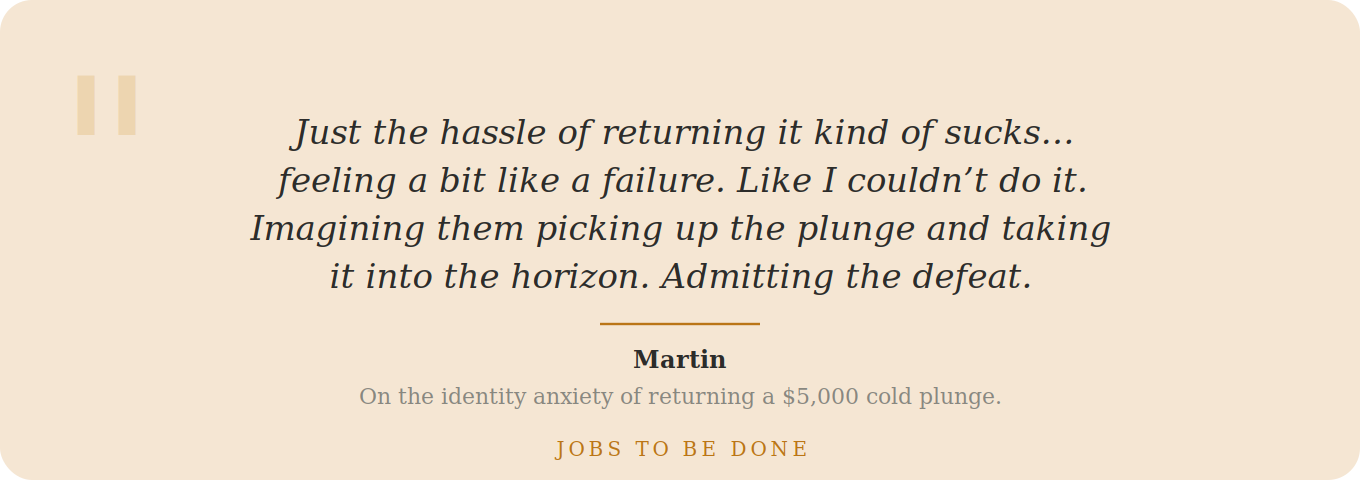
Third: what happens if he fails? The plunge costs around $5,000. Martin pictured the specific scenario of calling to arrange a return. “Just the hassle of returning it kind of sucks,” he told us. But it was more than logistics. “… feeling a bit like a failure. Like I couldn’t do it. Imagining them picking up the plunge and taking it into the horizon. Admitting the defeat.”
Two conversations helped lower the anxiety enough to move forward. Martin’s personal coach, who lives in Florida, mentioned he owned the same brand and kept it outdoors. When Martin asked if the cold plunge was worse than cold showers, his coach said he thought cold showers were actually worse because the water hits you in irregular places, while in a plunge you sit still and your body adjusts. “I’m not sure I believe that,” Martin told us, “but at least it’s an empowering belief.” The second conversation happened at a park with friends. One did open water swimming and liked cold water. Another had done a homemade ice bath at home. Neither had a plunge, but they normalized the idea.
Martin pulled the trigger while on vacation in Europe at the end of August or beginning of September 2023. They were in a hotel room in the evening, their daughter already in bed. Martin had his laptop open, showing his wife the website. He’d been flirting with the idea and wanted her blessing. She was never enthusiastic about using it herself (cold water is “her kryptonite”), but she said something to the effect of: it’s investing in health, and investing in health is a good idea. They had read a book together that year called Die With Zero, about not deferring health investments as you age. That framing helped.
He chose the smaller, residential, standard model. Around $5,000. It arrived about a month later via FedEx, during a heat wave. He ended up putting it outside under a carport he hadn’t originally considered. His first session was a late afternoon, around 5 or 6 PM, while his daughter played outside with her nanny. Three minutes. Intense pain. “Almost like I’m about to start crying,” he said. After about a week, he started getting used to it.
Listen to the full Jobs-to-be-Done customer interview with Martin to see how I teased out the anxiety that was holding back the purchase:

The Concept: Anxiety Reduction as Core Business Model
In the debrief after the interview, Martin said something that captures this concept perfectly: “These businesses are anxiety reduction businesses.”
The cold plunge company sells hardware. Tubs, chillers, filters. But look at what actually stalled the purchase for months. It wasn’t the price. It wasn’t competitors. It wasn’t a lack of desire or awareness. Martin had been building toward this purchase for years. Every source he trusted was pointing in the same direction. He had the money, the space, and the motivation.
What stalled him was a stack of anxieties: Can I physically handle this? Where does it go in my home? What if I fail and have to return it? Will my wife support this? Each anxiety was a gate. And the company did almost nothing to address any of them. When Martin reached out directly asking for help figuring out indoor placement, they gave him a vague answer and then stopped responding.
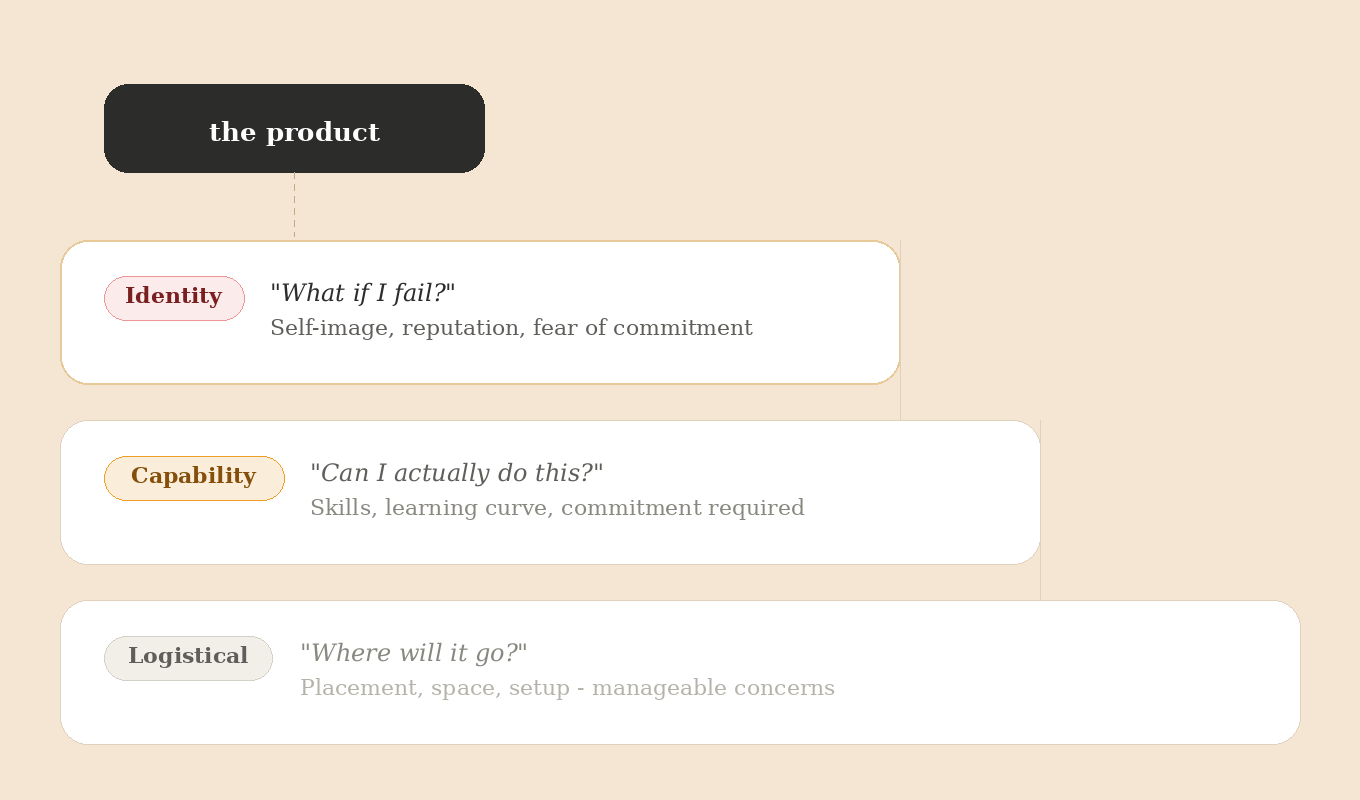
This is the concept: for many products, the primary barrier to purchase isn’t awareness, interest, or even price. It’s anxiety. And the company that treats anxiety reduction as its core business model (not a side benefit, not a FAQ page, but the actual organizing principle of how it sells) will close purchases that competitors leave on the table for months.
How to Use This in Your Work
Identifying the Anxiety Stack (make sure to ask these questions)
Mapping Anxiety Against the Timeline
Implications for Product Development and Strategy
Common Mmi
